

Everything beautiful I'm bringing home from Madrid, Morocco and Mallorca
Pleated lamp shades, fleur de lis and verde macael marble are my new personality traits

I just got back from a three-week mega trip to Madrid, Mallorca and Morocco and I honestly can’t remember the last time I was so inspired by a single vacation.
This trip in particular felt like time traveling between the ancient past (Morocco) and the distant future (Madrid and Mallorca), meanwhile none of these places were more than a 60 minute shuttle flight away from one another. Morocco felt like a full-tilt celebration of old-world opulence; this country is an economy of textiles and bespoke craftsmanship. OTOH, every retail and commercial space in Madrid and Mallorca felt like a fully functional, open-air modern art display, tucked away inside those big, heavyweight facades that remind you Spain is over 1,000 years old. This kind of contrast all over Spain was the through-line that created some of the most masterful examples of design I have seen in any of my travels to-date.
Admittedly, sometimes the one thing we want to do most — bring pieces of these beautiful places home with us — is the one thing that’s not possible. Sometimes concepts don’t translate when we return to where we live, materials that make three hundred year-old houses look like they simply rose from the earth they sit on in one part of the world look fake and contrived in another. Cough cough, the Spanish style McMansions trademarked by Californian cities like Los Altos and other wealthy suburbs of the Bay Area. And no matter how hard one might try, nowhere in the world will ever look like Mallorca except Mallorca.
Nonetheless when I get back from a trip I like to bottle everything that stuck with me into one big moodboard on every place I saw. I’ve word vomited my thoughts here, all my notes and half-baked ideas so I can’t forget them or forget what made these places feel so other-worldly. So without any further context and with little to no explanation, here’s all the inspo I’m bringing back from this trip.
MOROCCO…
Fleur de lis, clashing patterns, colorful tile
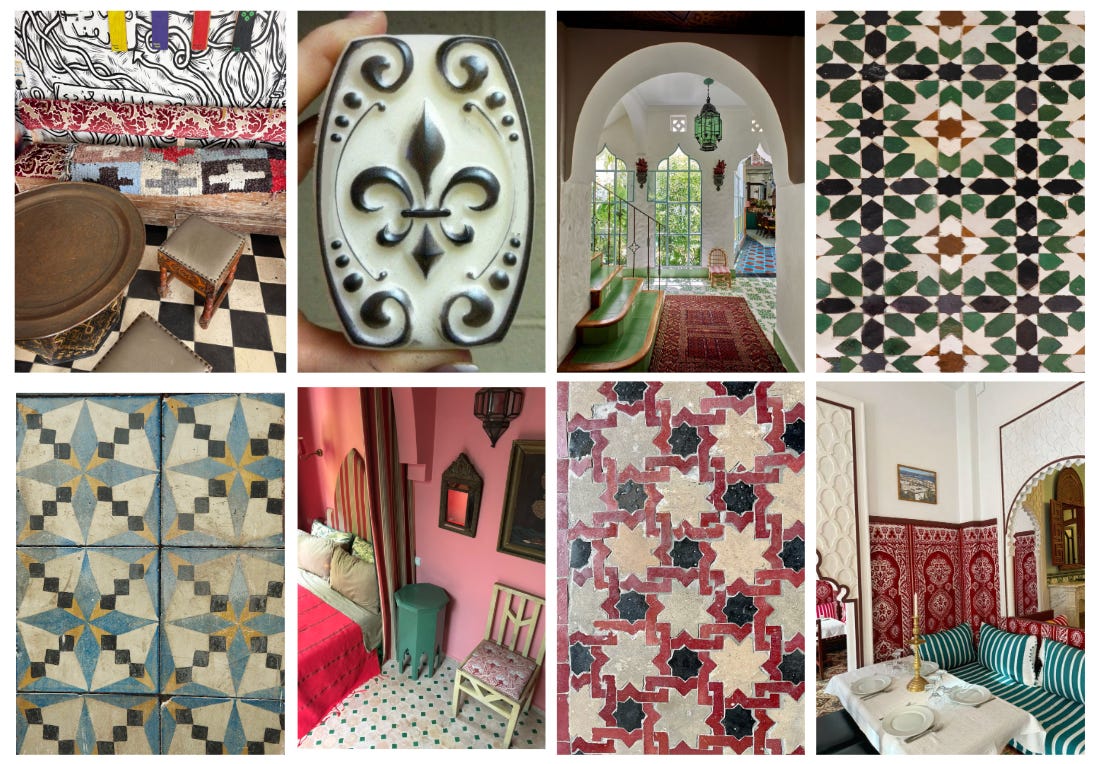
No wall, no floor, no headboard in Morocco is spared of color or pattern. None of the colors match, clashing patterns are often superfluously layered, and somehow it always works.
The fleur de lis was technically a colonial influence, but it became one with Moroccan design during the mid 20th c, when French Art Nouveau and Deco design fused with local craftsmanship in cities like Casablanca and Tangier (where I saw this motif everywhere). Some of what reads as “old world Morocco” is actually this specific 20th-century collision of Paris and the Maghreb.
Decorative towel hooks
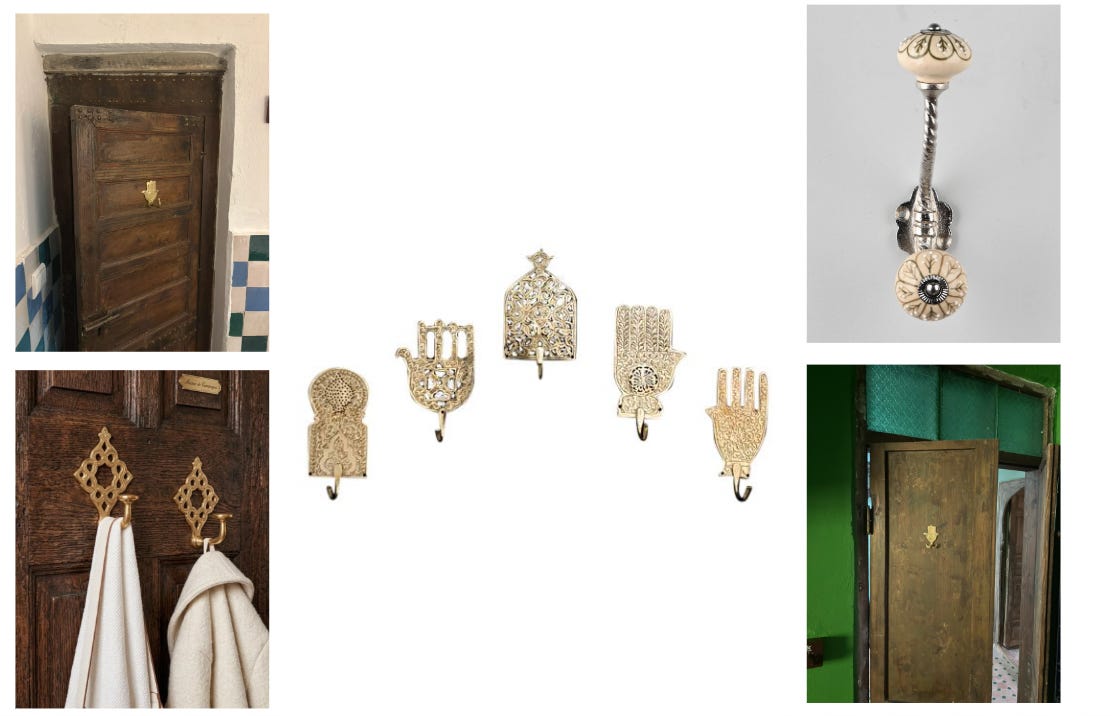
Someone, for the love of god, remind me why we took to using such unremarkable and utilitarian hardware in American residential design.
Riad hardware in Morocco descends from a much older tradition of Andalusian and Berber ironwork — hand-forged hooks, grilles and lanterns made by artisans in Fez and Marrakech, where even the most functional object was expected to carry ornament. I really enjoyed the pomp and circumstance of hanging up my towel after a shower in our airbnb, where almost every bathroom and bedroom door was decorated with one of these brass hamsa hooks.
Colorful pleated sconces
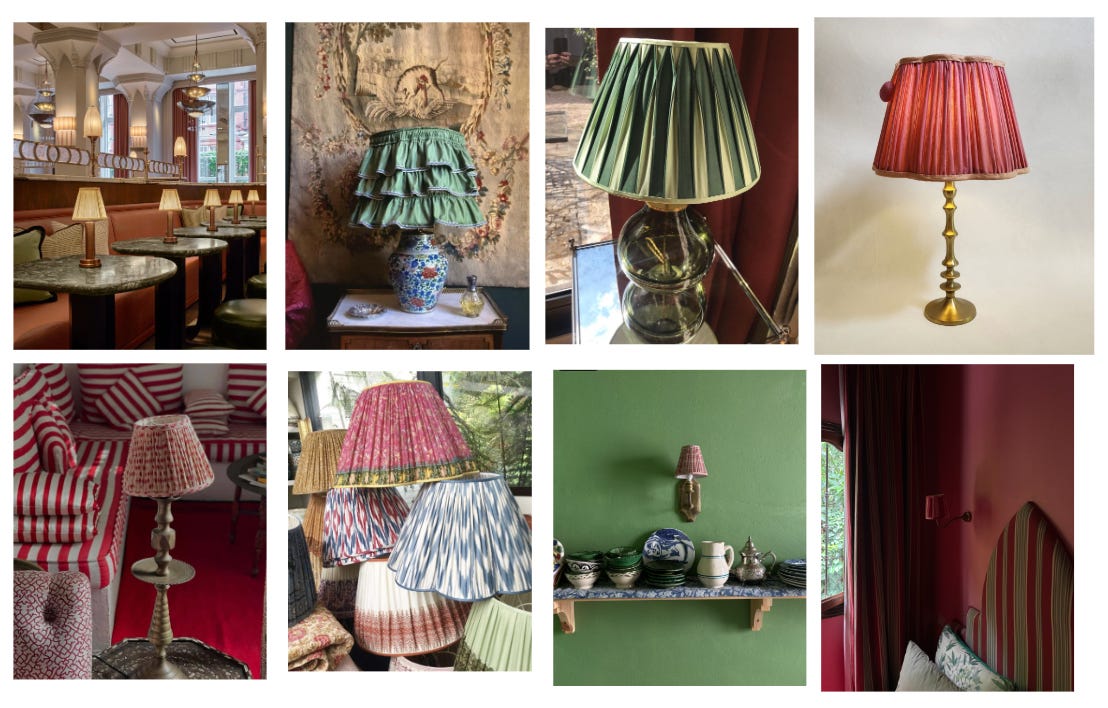
Pleated lamp shades like these date back to the Art Deco café culture the French brought to coastal Moroccan cities in the 1920s and ‘30s — think Casablanca’s white Deco boulevards. The pleat was a period signature, a way to bring Parisian tailoring logic into lighting design. And the colorful tendencies toward bright reds, pinks, and greens, well that’s just Morocco.
Rusted sterling silver cafe lamps
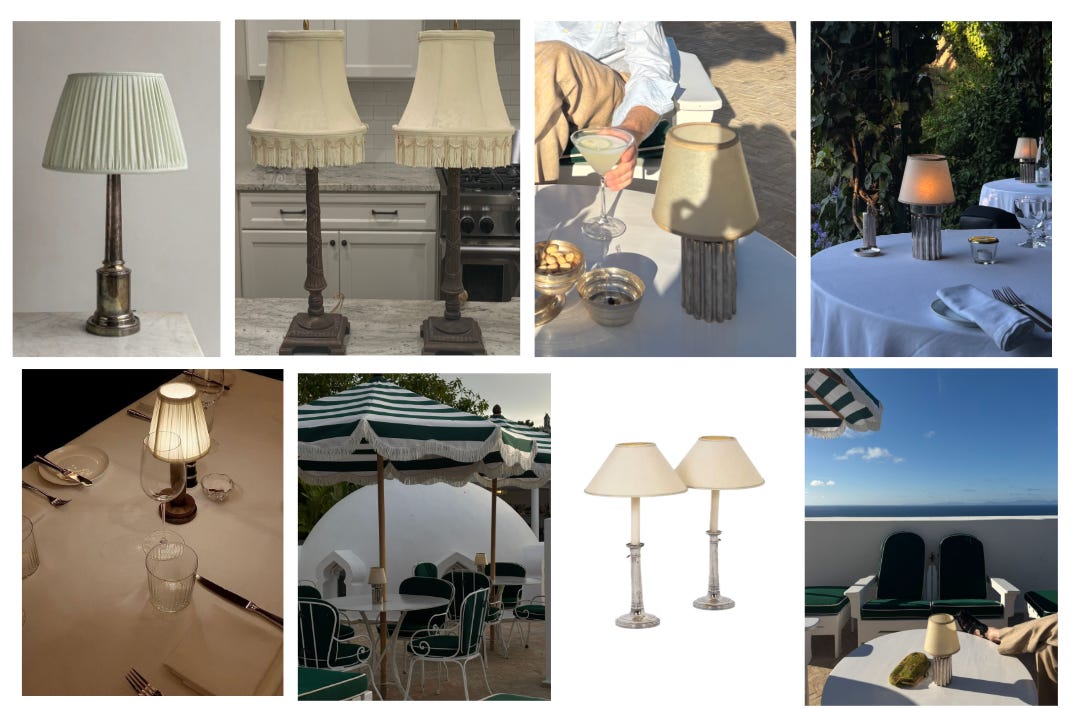
Stay with me on the lamps for a minute…
I learned on this trip that Morocco’s silversmithing tradition runs quite deep, which explains some of the unbelievable sterling pieces I found for for next to nothing in Tangier, from what looked like the junk drawer of some guy’s grandpa’s garage. Berber and Jewish artisans in towns like Tiznit and Fez worked silver for centuries using techniques originally developed for jewelry and dowry pieces. Eventually the craft made its way into lighting and home decor, and lamps became a new object for this art form to live on.
I saw these gorgeous patinaed sterling cafe lamps with delicate ivory shades all over British designer Jasper Conran’s hotel Villa Mabrouka, and ever since I’ve been obsessed with finding the perfect pair to style atop my kitchen counters.
MADRID…
Cherry red EVERYTHING.
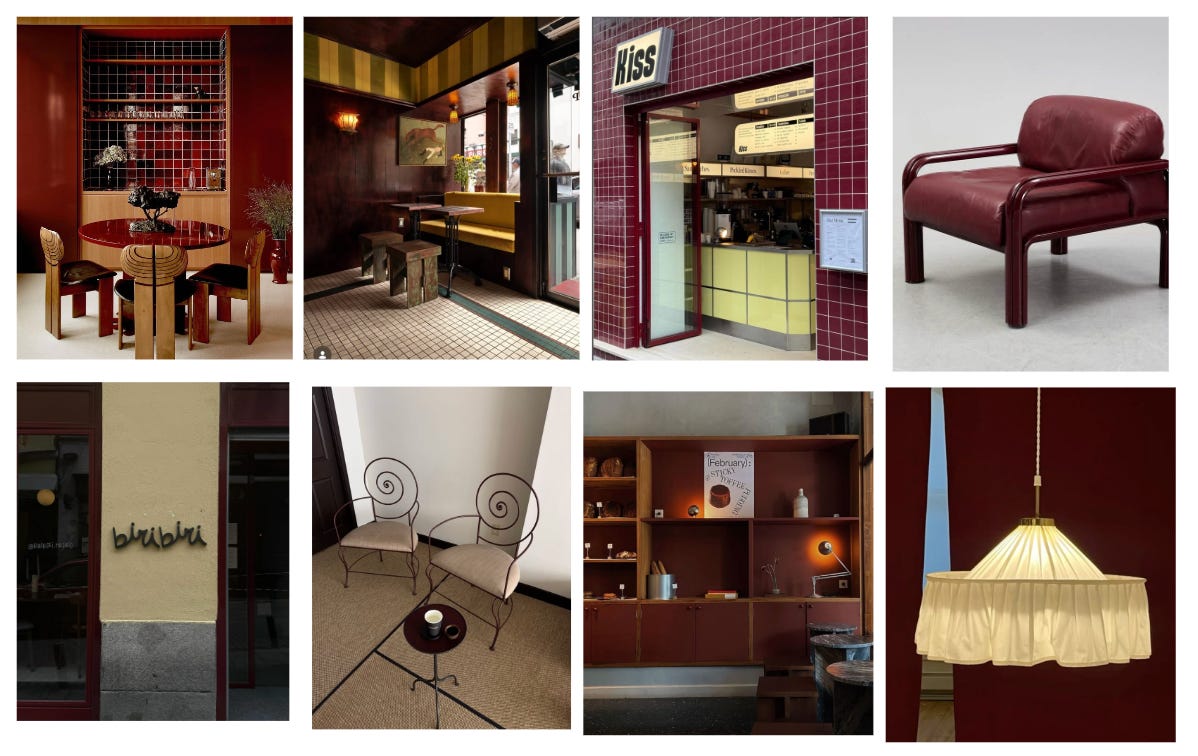
I don’t know much about auras but let me just tell you, I know Madrid’s aura is red. Bold use of color as a design statement in Spain is not a novel phenomenon — after decades of Francoist conservatism, the Movida Madrileña of the late ‘70s and ‘80s used bold, unapologetic color as a visual language of liberation. Everywhere I went I saw cherry red, especially in restaurants and coffee shops where you might not typically expect to find yourself sitting in such a dark and moody, yet warmly saturated interior setting.
Stainless steel for retail
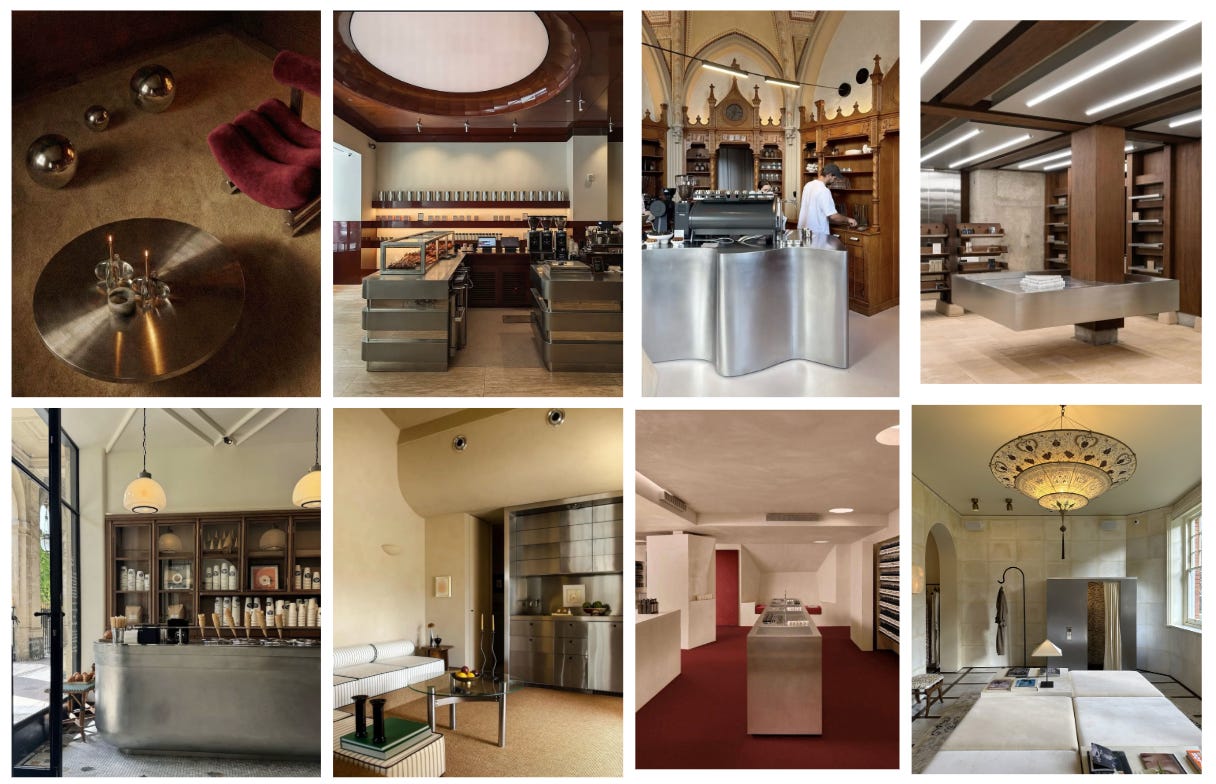
Steel’s return to hospitality feels like an echo of the raw-industrial instinct that shaped Spain’s brutalist civic architecture boom in the ‘60s and ‘70s. What was once purely structural and utilitarian now reads like a finish worth showing off — big stainless coffee bars and counter tops were the tell-tale signs that whatever you were about to eat or drink was going to be good. Kind of giving a return-to-art-deco vibe.
Verde Macael marble
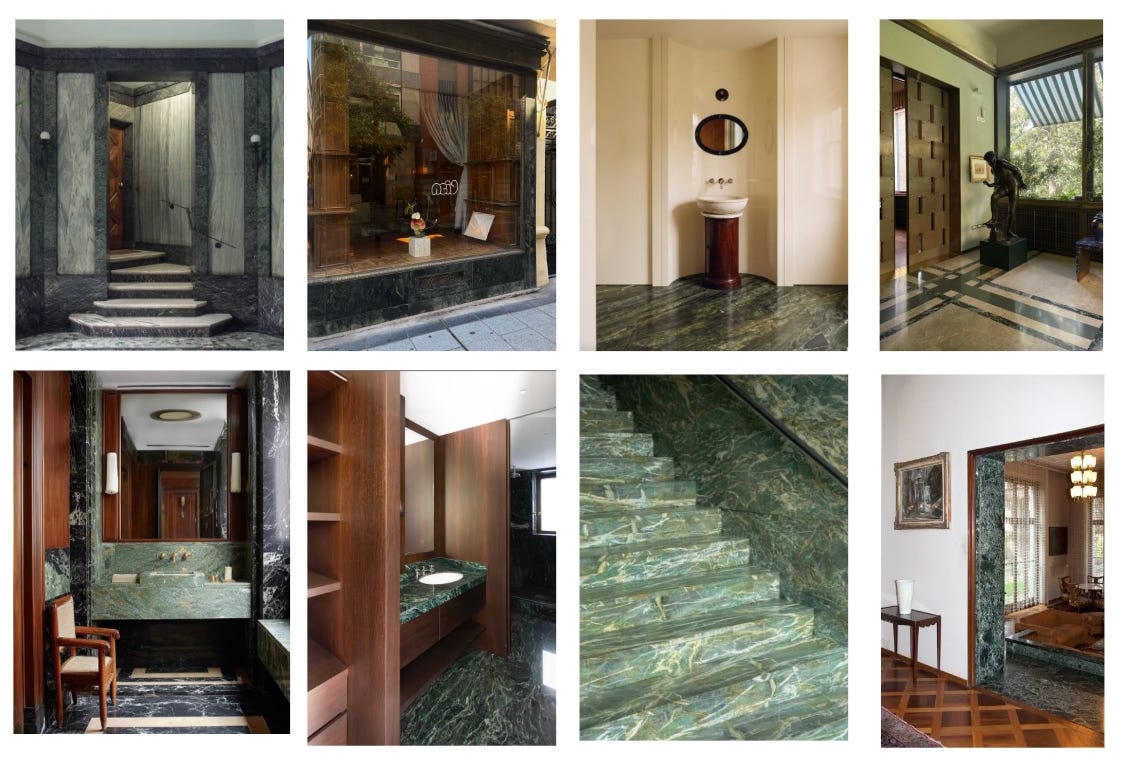
This is a serpentine green stone quarried specifically around Macael, in Almería — a marble region that has supplied Spain since Roman and Moorish times, most famously the white marble columns of the Alhambra’s Court of the Lions. While this characteristic stone is not new to the architectural landscape of Madrid, the hospitality industry there has seemingly trademarked a gorgeous trifecta of a design scheme: green marble, walnut and glass. Everywhere I went, heavy verde macael facades were complemented by sleek, moody interiors blanketed in seamless walnut paneling and big glass retail windows.
MALLORCA…
British racing green and sand stone
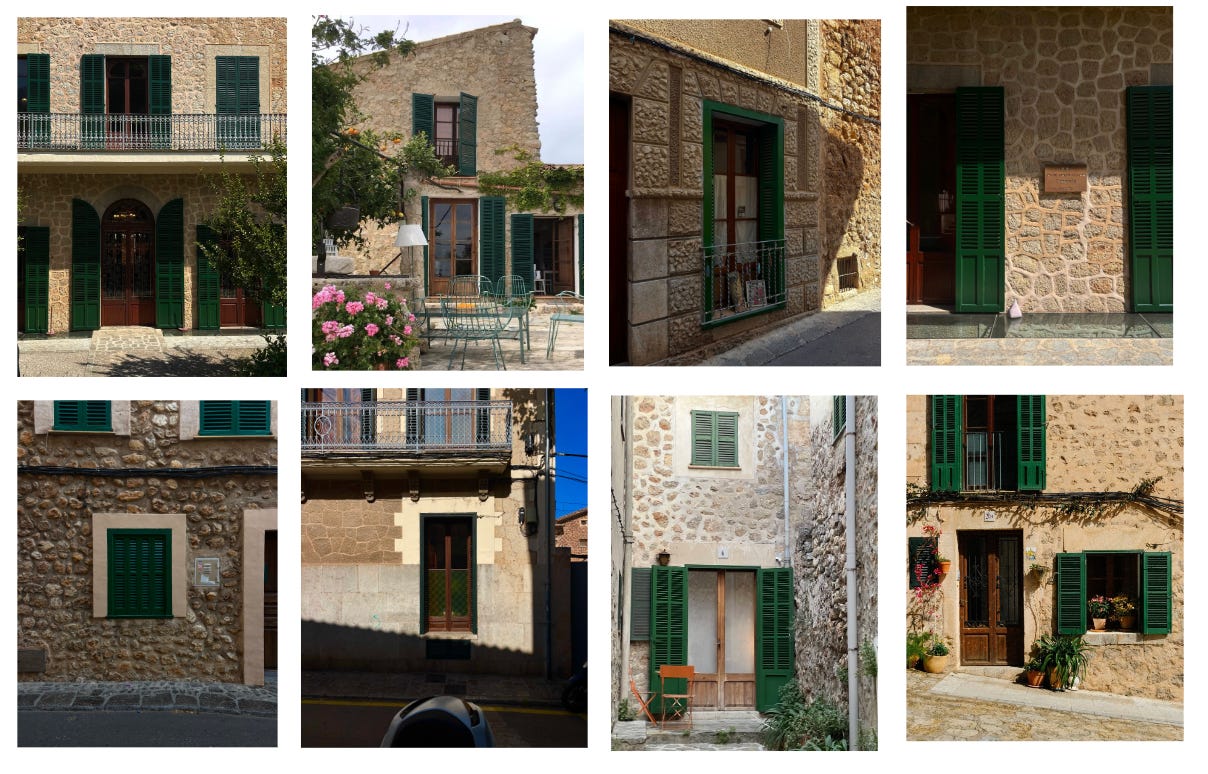
Almost all of the shutters (persianas) on Mallorca are painted the same shade of British racing green. The shutters aren’t just pretty, they are also practical. This distinctive green hue (a piece of architectural identity now protected by municipal building code) was more durable to salt air and sun damage due to its original formulation with copper-based pigments like verdigris or copper arsenate. Some say this tradition started with cheap surplus military paint being sold on the black market in the 1800s.
Not only does the contrast on marès (the local calcareous sandstone) create a beautiful combination, the dark green hue seems to emulate so many natural phenomena that make the island so distinctively beautiful: the rugged green mountain ranges that flank towns like Sóller and Deià, and the warm shadows that start to make the sandy buildings glow when the sun starts to fall at 5pm.
Xoxoxox,
Julia
Loved this! I always try to journal about places I visit: my first impressions when I get there and some final thoughts after I leave. Alas, a ton of detail gets lost in just handwriting and the incomplete history lessons I get from frantic Google searches as I come across things I hadn’t read about during the trip. Big fan of how you’ve captured so well the little things you didn’t want to forget. Will be stealing this format to make use of the ton of pictures I never look back on!! Thanks for the inspo 🧡